بِسْمِ اللَّهِ الرَّحْمَنِ الرَّحِيمِ
بِسْمِ رَبِّ الْحُسَيْنِ عَلَيْهِ السَّلام
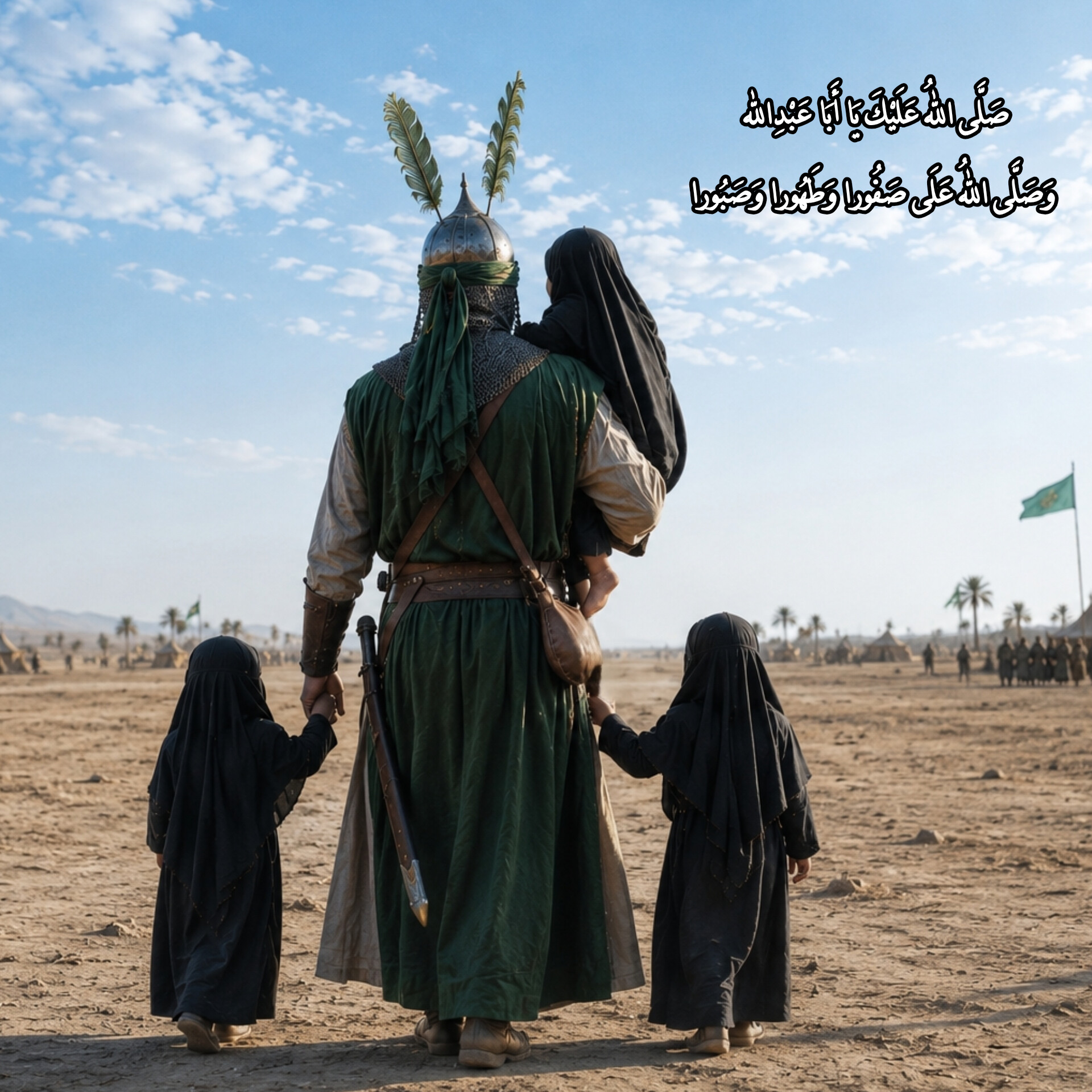
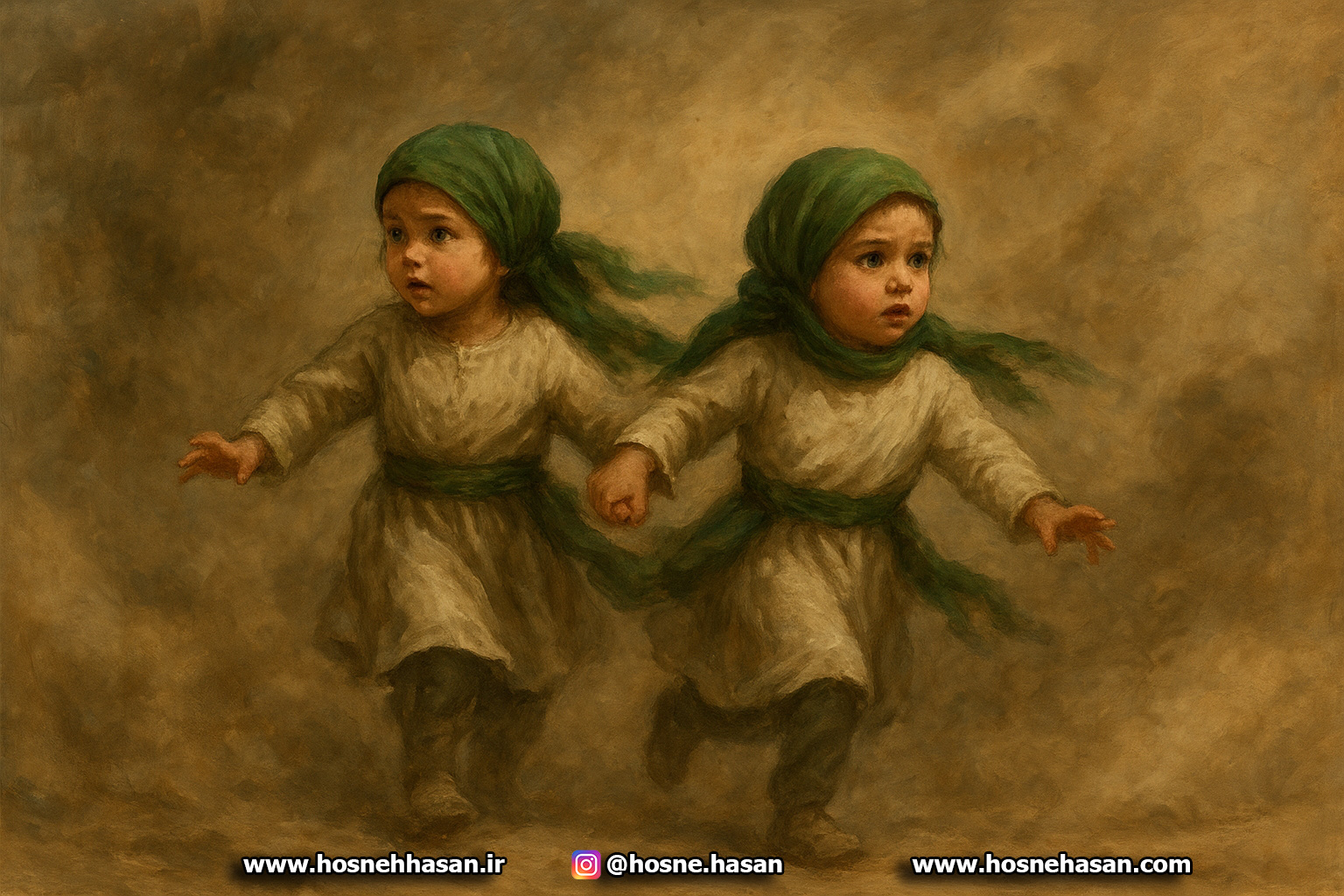
Three unnamed pearls of KarbalaSafoora & Tahoora & Saboora Daughters of Imam Hussain (a.s.)
The story of the lives and martyrdom of three daughters of Imam Hussain (a.s.), whose names — after more than 1300 years of anonymity — were made known through Allamah Hasanzadeh Amoli.
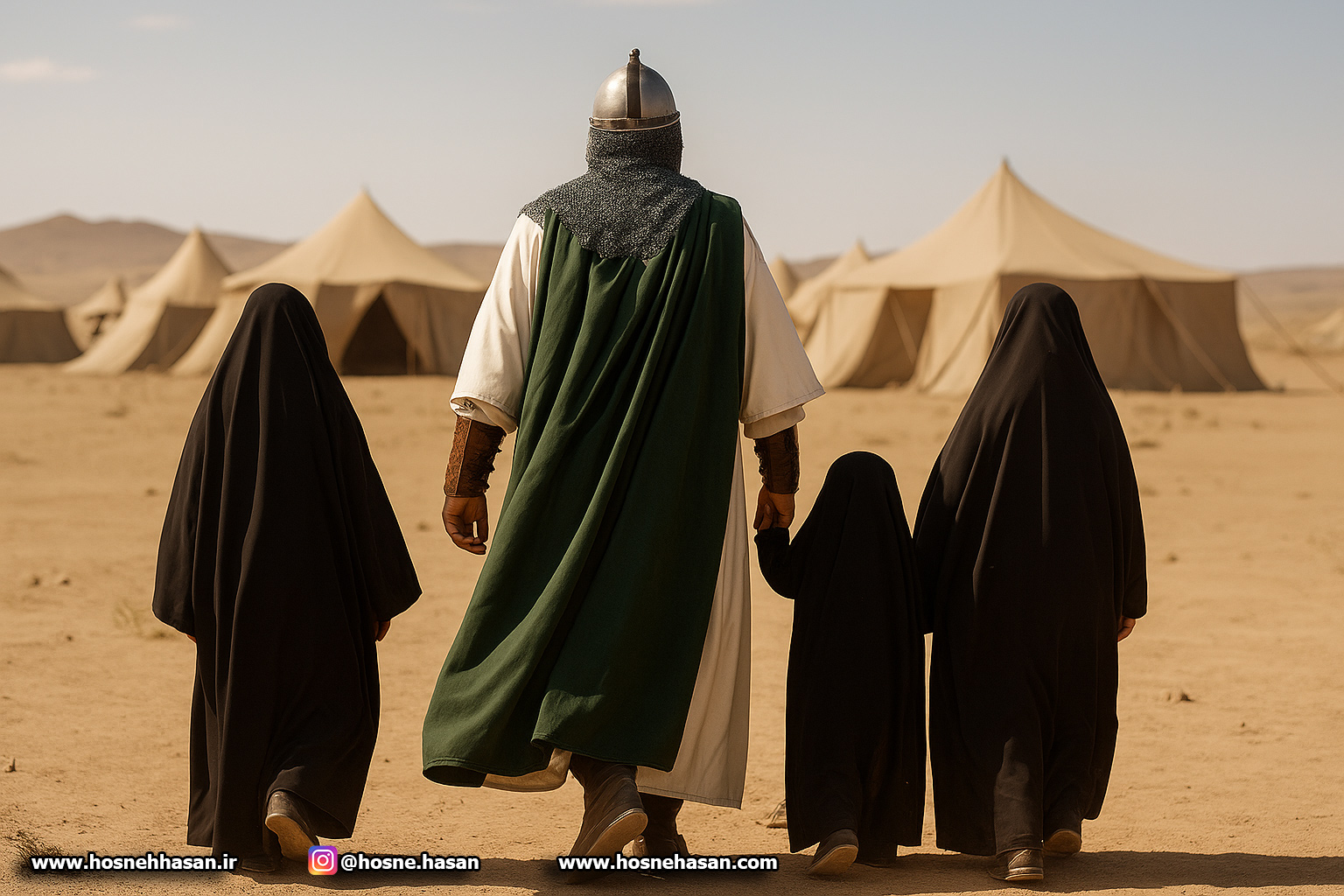
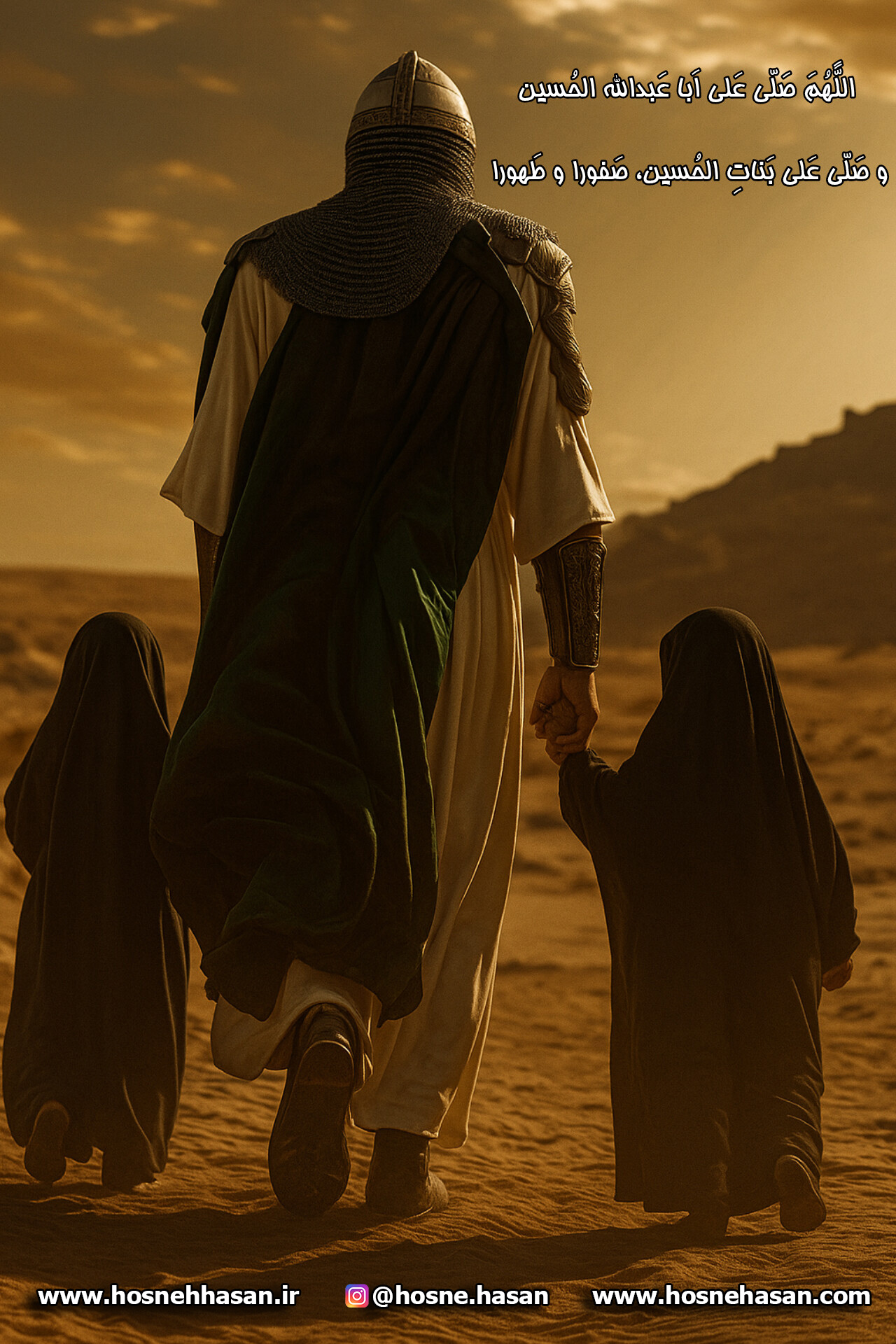
Safoora (a.s.), Tahoora (a.s.) and Saboora (a.s.) are three beloved daughters of Aba Abdillah al-Hussain (a.s.). Their presence in Karbala and the manner of their martyrdom are recorded in various histories and maqatil (martyrdom chronicles). Their names, however, were drawn from the unseen by Allamah Hasanzadeh Amoli: in a spiritual unveiling, the names of these daughters of Aba Abdillah al-Hussain (a.s.) and the manner of their martyrdom were shown to him. On Ashura of the year 1375 (solar hijri, 1996 CE) he made their names known publicly for the first time, after more than 1300 years in which these daughters of Imam Hussain (a.s.) had remained unnamed.
The assault on the tents and the martyrdom of the three children
What the martyrdom chronicles record about the assault on the tents and the martyrdom of the three children:
Aba Abdillah (a.s.) instructed Lady Zaynab (a.s.) to watch over the children and to gather them after the attack on the tents. When that godless army, on horse and on foot, fell upon the tents to plunder them, Lady Zaynab (a.s.) sought instruction from Imam Sajjad (a.s.), and he ordered them to flee the tents. The children and the grieving, sorrowful women fled; some accounts record that they went towards the place of the slain. After this, Lady Zaynab (a.s.) set about gathering the children, and some were missing. They searched for them across the plain of Karbala, until they found two children who had died beneath a tree.
At that point the enemy set about burning the tents of the Ahl al-Bayt (peace be upon them) while the women and children were still inside. They brought torches of fire, one of them crying out: "Burn the houses of the oppressors!" — and they cast fire into the tents. The daughters of the Messenger of God came out of the tents and fled while the fire pursued them from behind. Some of the orphaned children clutched at their aunt's garment to be sheltered from the fire and safe from the cruelty of the enemy; some scattered into the wilderness; and some pleaded for help from those tyrants whose hearts were empty of mercy and compassion. The enemy vied with one another in plundering the Husayni tents, to the point of pulling the head-coverings from the women. The daughters of the House of the Prophet came out of their quarters, all of them weeping and lamenting the loss of their loved ones and elders. Throughout his life after the martyrdom of Imam Hussain (a.s.), whenever Imam Sajjad (a.s.) recalled the bitter memories of the day of Ashura, he would say with tears and deep grief: "By God, I never look at my aunts and sisters without a lump rising in my throat, and I remember those moments when they fled from tent to tent while the herald of the Kufan army cried out: burn the tents of these oppressors!"
Humayd ibn Muslim says: Umar ibn Sa'd came near the Imam's tents. The women rose, faced him, cried out and wept. So he said to his companions: "No one may enter the tents of these women, nor trouble this sick young man (Imam Sajjad)." The women asked him to return their plundered clothing so that they might cover themselves. Umar ibn Sa'd said: "Whoever has taken anything belonging to these women, let him return it." By God, not one of that company gave anything back. Umar ibn Sa'd then posted a group at the tents and quarters of the women and ordered them to guard them, so that none should leave the tents and none should harm them. Then Umar ibn Sa'd returned to his own tent.
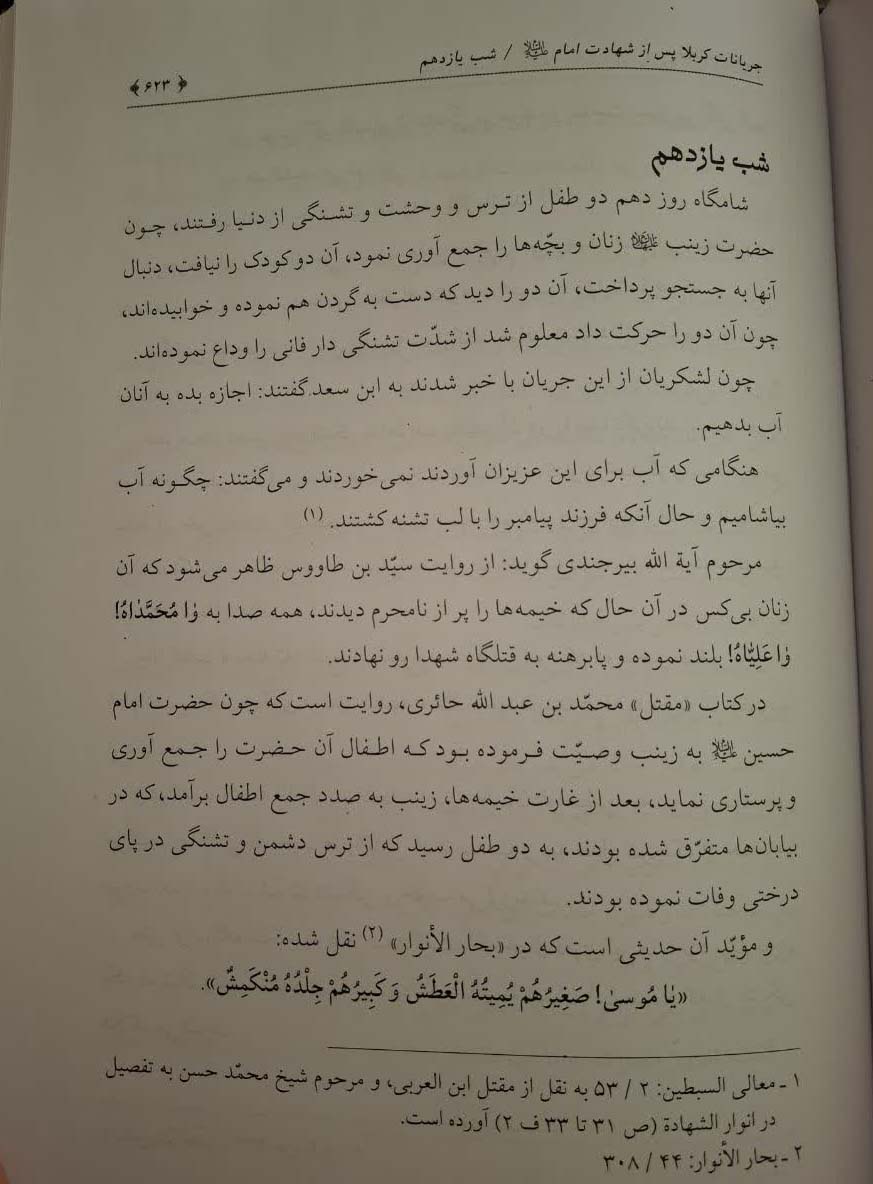
The author of Ma'ali al-Sibtayn relates that on the evening of Ashura two children died from terror and thirst. When Zaynab al-Kubra searched to gather the family and the children she could not find those two, until she found them with their arms around each other's necks; they had passed from this world.
In al-Iqad it is related from the Maqtal of Ibn Arabi that two children of the Ahl al-Bayt died on the tenth day from extreme terror, fear and thirst. When Lady Zaynab (a.s.) gathered the women and children, two of the children were missing. Lady Zaynab (a.s.) searched for them until she found them asleep, holding one another in an embrace. When they moved the two children, they realised that they had died of thirst.
On the evening of the tenth day two children died of fear, terror and thirst. When Lady Zaynab (a.s.) gathered the women and children she could not find those two. She searched for them and saw them lying asleep with their arms around each other's necks; when she moved them, it became clear that they had departed this fleeting world from the severity of thirst.
When the soldiers learned of this they said to Ibn Sa'd: give us leave to bring them water.
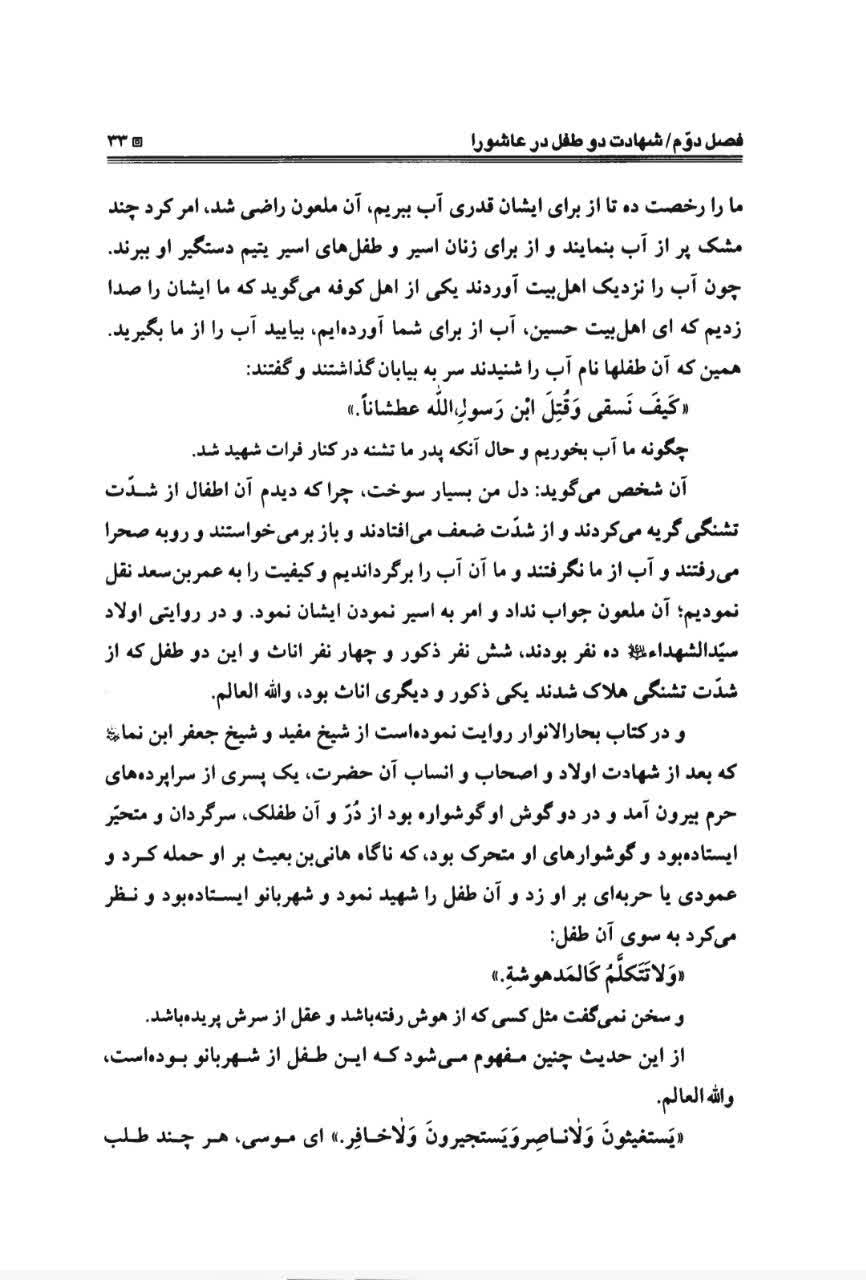
But when water was brought to these dear ones, they would not drink and said: how shall we drink water when the son of the Messenger of God was killed with parched lips? (Ma'ali al-Sibtayn 2/53, from the Maqtal of Ibn al-Arabi; Shaykh Muhammad Hasan gives it in detail in Anwar al-Shahada, pp. 31–33, ch. 2.)
The late Ayatollah Birjandi says: it appears from the narration of Sayyid ibn Tawus that those defenceless women, seeing the tents filled with strangers, all raised their voices with "Wa Muhammada!" and "Wa Aliyya!" and set out barefoot towards the place of the slain.
In the Maqtal of Muhammad ibn Abdullah al-Ha'iri it is narrated that, since Imam Hussain (a.s.) had charged Zaynab (a.s.) with gathering and caring for his children, after the plundering of the tents Zaynab set about gathering the children who had scattered across the plains. She came upon two children who had died at the foot of a tree from fear of the enemy and from thirst.
This is supported by the tradition related in Bihar al-Anwar 44/308:
«یا موسی! صَغِیرُهُم یُمِیتُهُ العَطَشُ وَ کَبیرُهُم جِلدُهُ مُنکَمِشُ.»
"O Moses, their little ones die of thirst, and the skin of their grown ones is shrivelled."
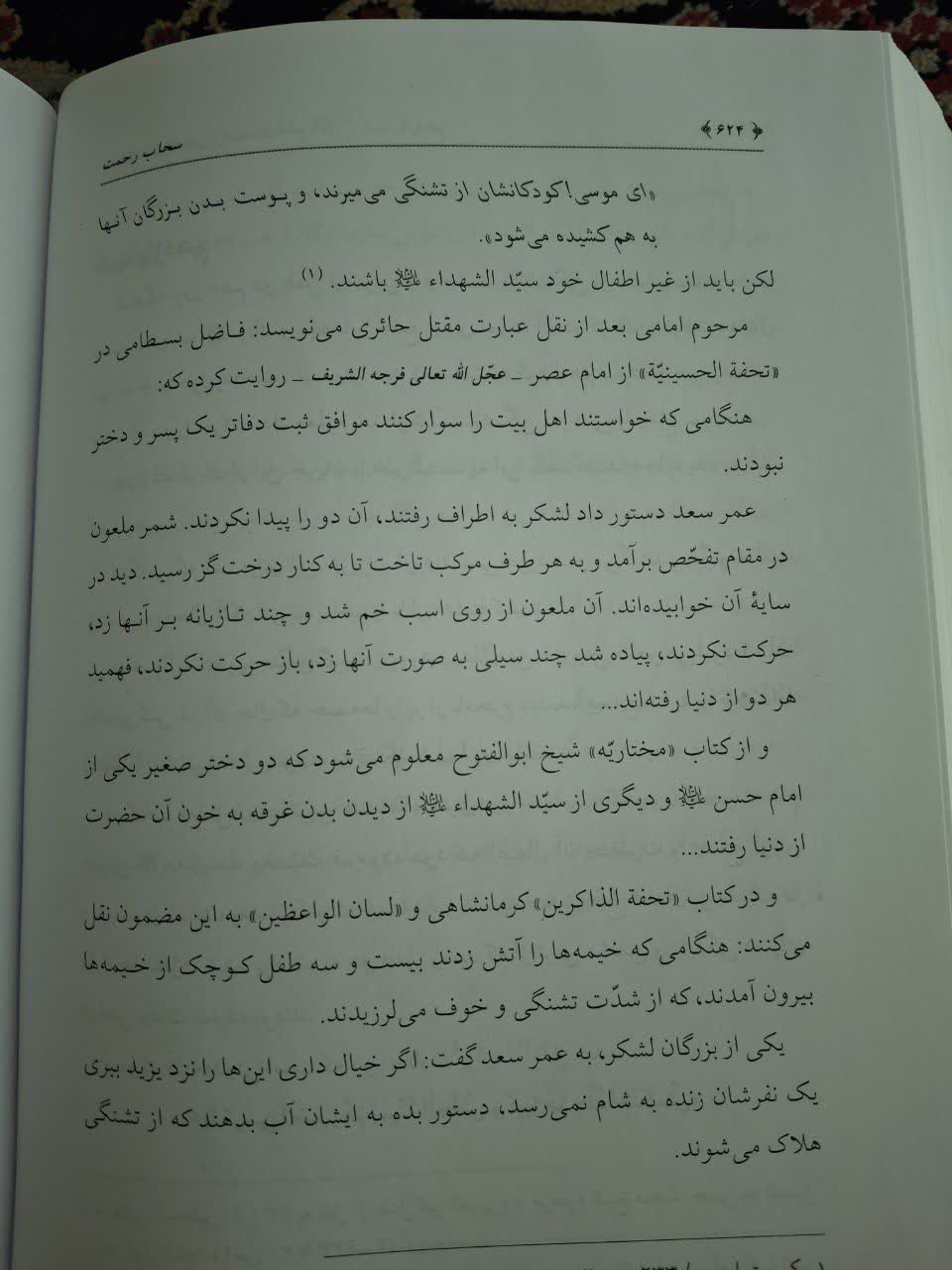
However, these must be children other than those of Sayyid al-Shuhada (a.s.) himself.
After quoting the passage from the Maqtal of al-Ha'iri, the late Imami writes: Fadil Sabzawari in Tuhfat al-Husayniyya narrated from the Imam of the Age (may God hasten his reappearance) that:
When they wished to mount the Ahl al-Bayt for the journey, according to the registers one boy and one girl were missing.
Umar ibn Sa'd ordered the army to spread out; they did not find them. The accursed Shimr undertook the search and rode in every direction until he reached a tamarisk tree. He saw them asleep in its shade. That accursed one bent down from his horse and struck them several times with his whip; they did not move. He dismounted and struck their faces several times; still they did not move. He realised that both had left this world…
From the book al-Mukhtariyya of Shaykh Abu al-Futuh it appears that two small girls — one of Imam Hasan (a.s.) and one of Sayyid al-Shuhada (a.s.) — died from the sight of his body drenched in blood…
And Tuhfat al-Dhakirin of Kirmani and Lisan al-Wa'izin relate to this effect: when the tents were set on fire, twenty-three small children came out of them, trembling from severe thirst and fear.
One of the commanders of the army said to Umar ibn Sa'd: if you intend to take them to Yazid, not one of them will reach Damascus alive; order that they be given water, for they are perishing of thirst.
8 — The two lost children
Age: unknown. Lineage: unknown. Martyrdom: they were martyred as a result of terror and thirst.
The maqatil mention two children who, in the tumult of the battle, took shelter beneath a thorn bush and were martyred under it from severe thirst and fear.
After the plundering and burning of the tents, the stricken women and children scattered into the wilderness. Lady Zaynab (peace be upon her) gathered them, and on counting the children realised that two were missing. She called out to her sister Umm Kulthum: come and see, two children are missing.
The two grief-stricken sisters set out into the desert to find the children and searched everywhere, until at last they saw those two flowers of the Husayni garden beneath a bush of mughaylan thorn, asleep with their arms around each other's necks.
But when they came forward to lift those flowers from the ground and wake them, they were met with a sorrowful, heart-rending sight whose grief was very heavy to bear.
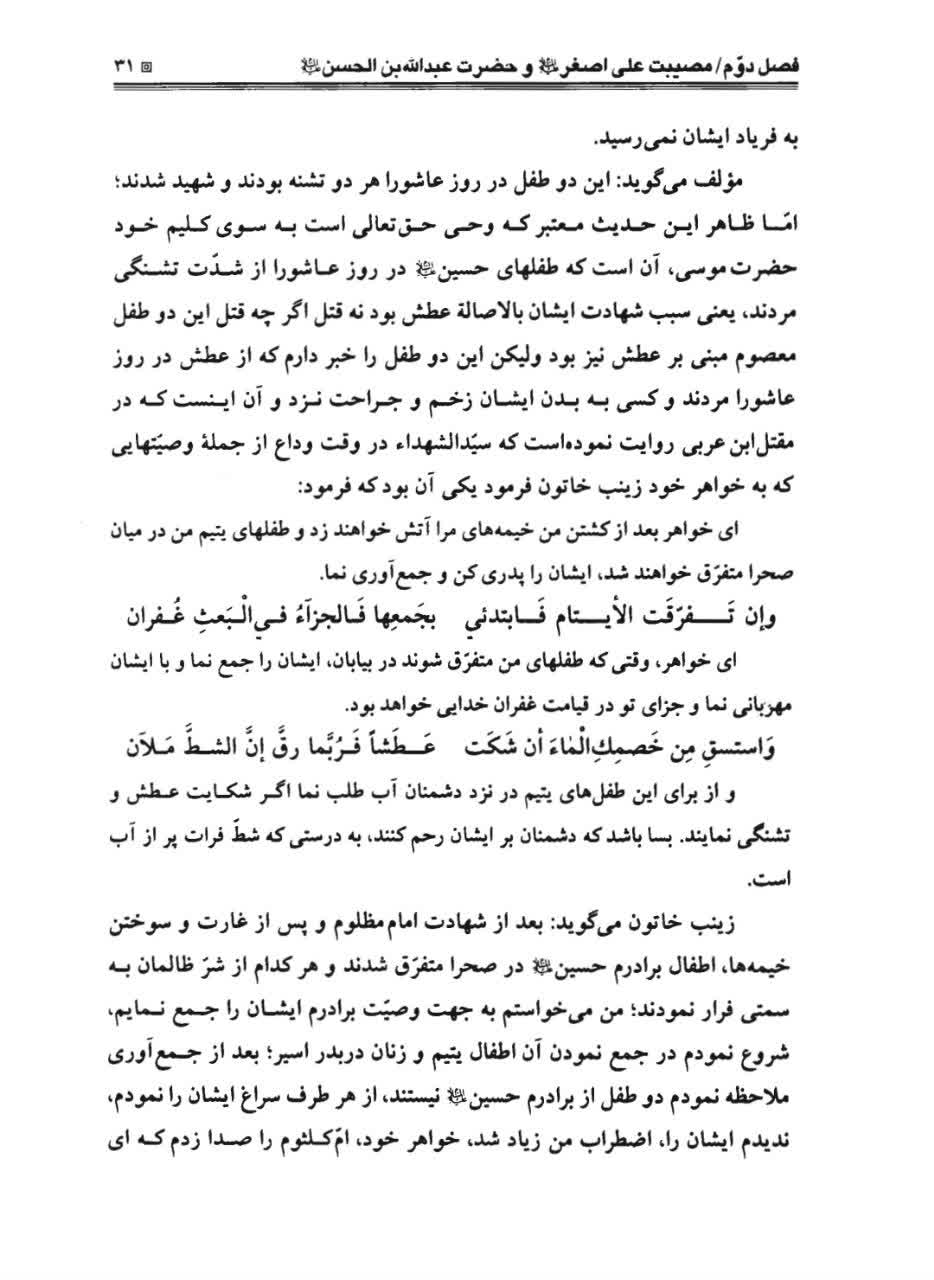
The author says: these two children were both thirsty on the day of Ashura and were martyred. But the apparent sense of this reliable tradition — which is a revelation of the Almighty to His interlocutor Moses — is that the children of Hussain (a.s.) died on the day of Ashura from severe thirst. That is, the cause of their martyrdom was essentially thirst rather than being slain, even though the killing of these two innocent children was itself bound up with thirst. Yet I know of these two children that they died of thirst on the day of Ashura and that no one inflicted any wound upon their bodies. This is what is narrated in the Maqtal of Ibn Arabi: that at the time of farewell, among the counsels Sayyid al-Shuhada gave to his sister Zaynab (a.s.) was this:
O sister, after I am killed they will burn my tents and my orphaned children will scatter across the desert. Be as a father to them and gather them.
وَإِنْ تَفَرَّقَتِ الْأَیْتَامُ فَابتدئی بجْمَعْهَا فَالْجَزَاءُ فِی الْبَعْثِ غُفْرَانٌ
O sister, when my children scatter in the wilderness, gather them and be gentle with them, and your reward on the Day of Resurrection will be God's forgiveness.
وَاسْتَسْقِ مِنْ خُصَمکِ الْمَاءَ إِنْ شَکَتْ عَطَشاً فَرُبَّمَا رَقَّ إِنَّ الشطّ مِلْآن
And ask water from the enemy for these orphaned children if they complain of thirst; perhaps the enemy will show them mercy, for the Euphrates is full of water.
Lady Zaynab (a.s.) says: after the martyrdom of the oppressed Imam, and after the plundering and burning of the tents, my brother Hussain's children scattered across the plain, each fleeing in a different direction from the malice of the oppressors. Because of my brother's counsel I wished to gather them, so I began to gather those orphaned children and the displaced captive women. After gathering them I noticed that two of my brother Hussain's children were not there. I searched for them in every direction and did not see them; my distress grew. I called my sister Umm Kulthum: O sister, my brother's two children are missing. Come, let us go to the place of the slain — perhaps they have gone to their father's body.
Zaynab says: we set out for the place of the slain and did not see them. I said: O sister, these two children were thirsty; perhaps they have gone to the bank of the Euphrates. Come, let us go to the Euphrates.
We came to the Euphrates, and however much we searched we did not see them, so we turned towards the wilderness. Zaynab came on weeping and calling to them, saying: my God, I do not know in which wilderness these two small children have perished, nor beneath the hooves of which horses they were trampled.
Zaynab (a.s.) says: I came to a hollow and saw a dark shape appear. When I drew near, I saw those two orphaned children fallen upon the hot sand, their arms around each other's necks, their delicate faces laid upon the sand and dust.
As soon as Zaynab (a.s.) saw this, she signalled to Umm Kulthum: come, O sister, I have found them — but softly, for they are sleeping and I fear they will wake. When Zaynab (a.s.) came forward she saw that their colour had turned pale, that they had wept so much that their tears had mixed with the dust, that dust had settled on their faces and entered their mouths, and that their eyes had sunk into their sockets.
Zaynab (a.s.) wished to lift them gently so that they would not wake, and to carry them to the Ahl al-Bayt. Suddenly she saw that their bodies had gone cold. She understood that they had left this world, perished from severe thirst, and bid farewell to this fleeting abode. So she took up the two children and went with them to Imam Zayn al-Abidin (a.s.) and the rest of the Ahl al-Bayt, and their grief was renewed; they began to weep and lament.
When this news reached some of the notables of the Banu Umayyah — may God curse them — they said to the accursed Umar ibn Sa'd: O Umar, you have done what you have done; but the family of Hussain (a.s.) bear no guilt and have come near to perishing from thirst, and two children have perished after the killing of Hussain (a.s.). Give us leave to carry them some water. That accursed one consented and ordered that several waterskins be filled and taken to the captive women and the captive orphaned children.
When the water was brought near the Ahl al-Bayt, one of the people of Kufa says: we called out to them: O family of Hussain, we have brought water for you; come and take it from us.
As soon as those children heard the word "water" they turned away into the wilderness and said:
«کَیفَ نَسْقِی وَقُتِلَ ابْنُ رَسُولِاللهِ عَطْشَاناً.»
How shall we drink water when our father was martyred thirsty beside the Euphrates?
That man says: my heart burned greatly, for I saw those children weeping from severe thirst and collapsing from weakness, then rising again and going out towards the desert, and they would not take the water from us. So we took the water back and reported the matter to Umar ibn Sa'd; that accursed one gave no answer and ordered that they be taken captive.
And in one narration the children of Sayyid al-Shuhada (a.s.) were ten: six sons and four daughters; and of these two children who perished from severe thirst, one was a boy and the other a girl — and God knows best.
Ziyarat al-Mufji'a of Lady Zaynab (a.s.)
The following words appear in the Ziyarat al-Mufji'a of Lady Zaynab (a.s.), referring to the martyrdom of these two daughters — Safoora (a.s.) and Tahoora (a.s.) — so beloved to Aba Abdillah al-Hussain (a.s.):
اَلسَّلامُ عَلى مَنْ تَکَفَّلَتْ وَاجْتَمَعَتْ فی عَصْرِ عـاشُوراءَ بِبَنـاتِ رَسُولِ اللهِ وَاَطْفـالِ الْحُسَیْنِ، وَقـامَتْ لَهَا الْقِیـامَةُ فی شَهـادَةِ الطِّفْلَیْنِ الْغَریبَیْنِ الْمَظْلُومَیْنِ.
Peace be upon her who took charge of and gathered together, on the afternoon of Ashura, the daughters of the Messenger of God and the children of Hussain (a.s.); and for whom the Resurrection itself arose at the martyrdom of the two forsaken and oppressed children of Imam Hussain (a.s.).
Who Safoora (a.s.), Tahoora (a.s.) and Saboora (a.s.) were, and how they were martyred
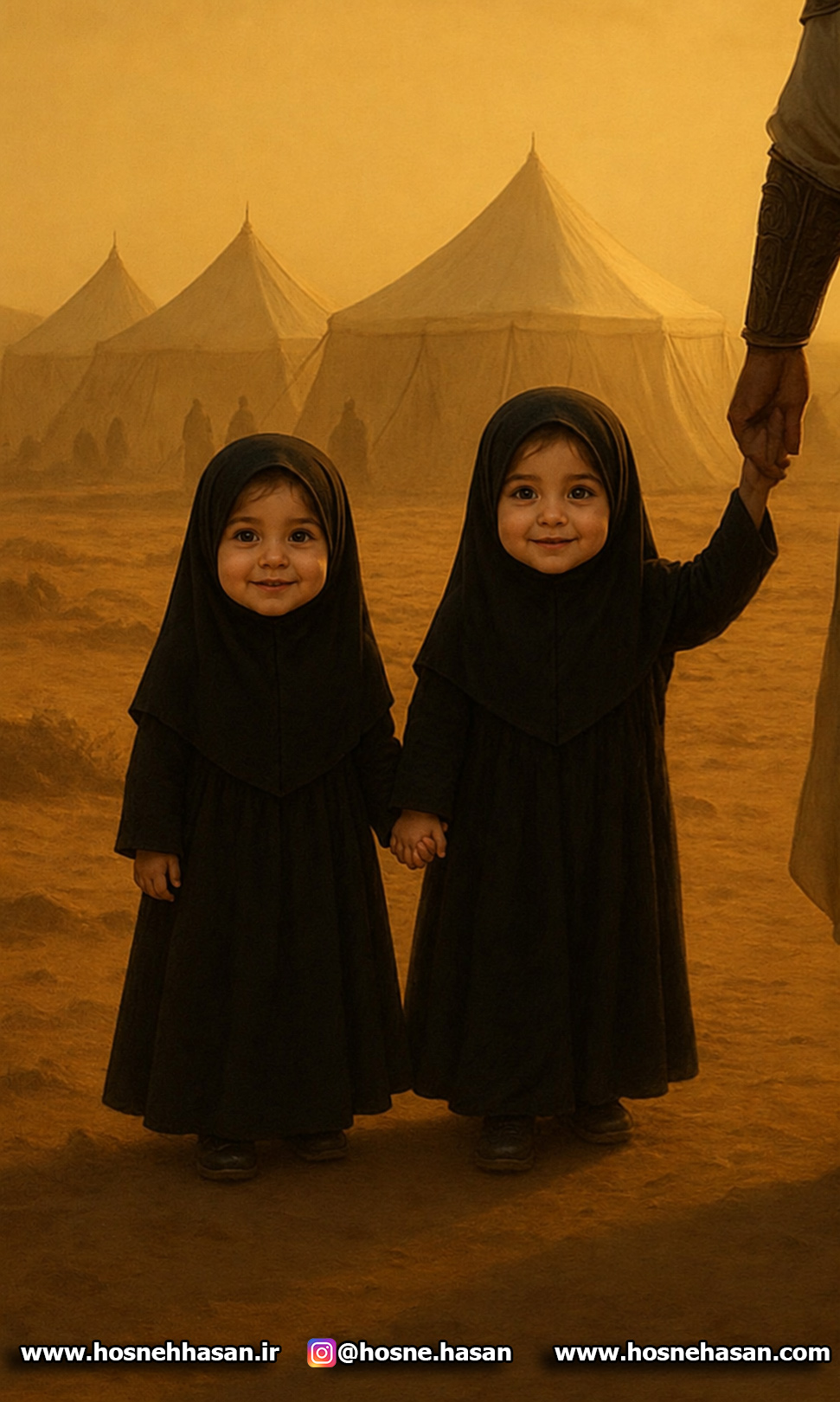
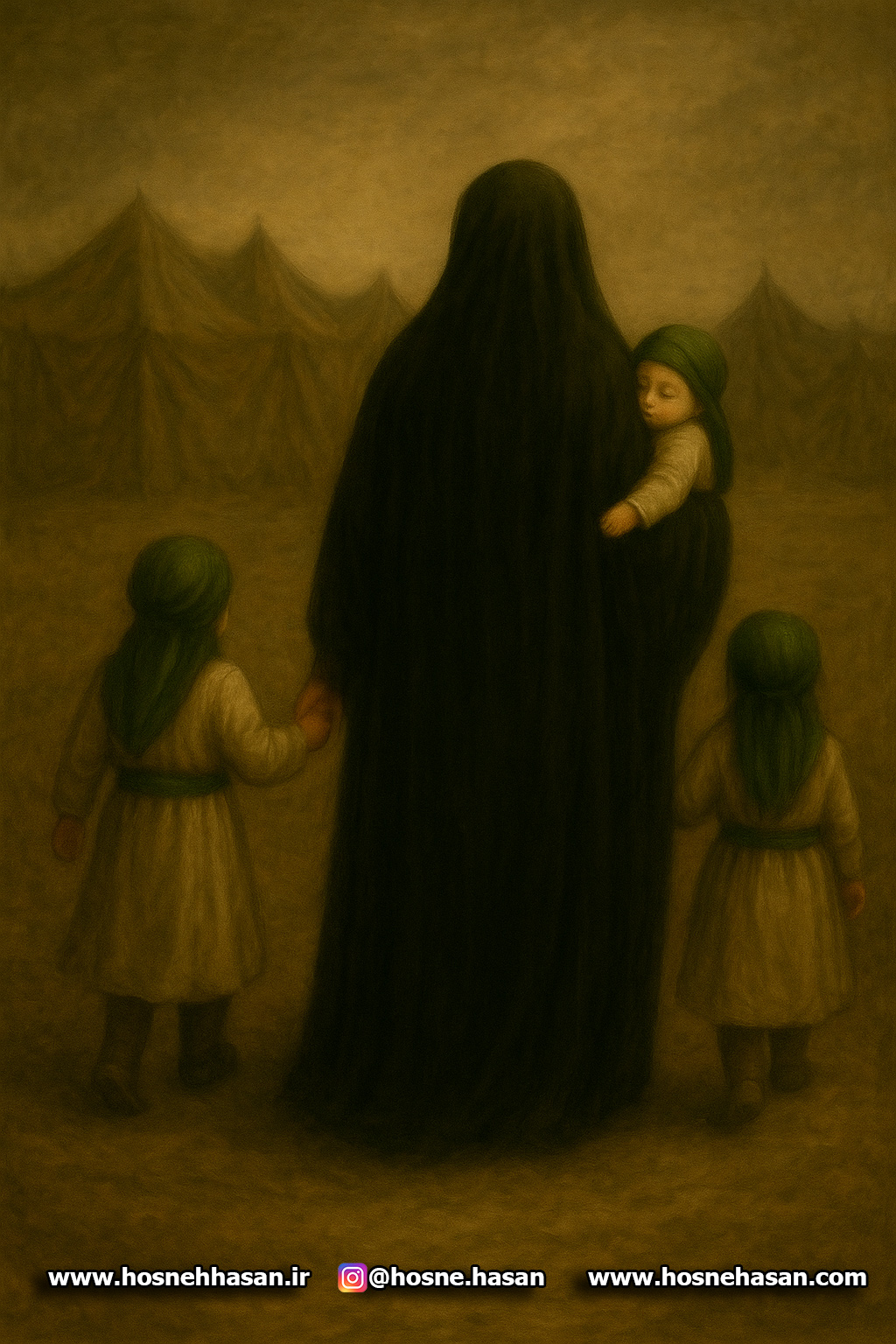
Safoora (a.s.) and Tahoora (a.s.) were the twin daughters of Imam Hussain (a.s.). On Ashura of the year 61 AH they were three years old, and they were the playmates of Lady Ruqayyah (a.s.). Their mother's name was Narges. Lady Saboora (a.s.) was another daughter of Imam Hussain (a.s.), and on Ashura of the year 61 AH she was only one year old.
How they were martyred
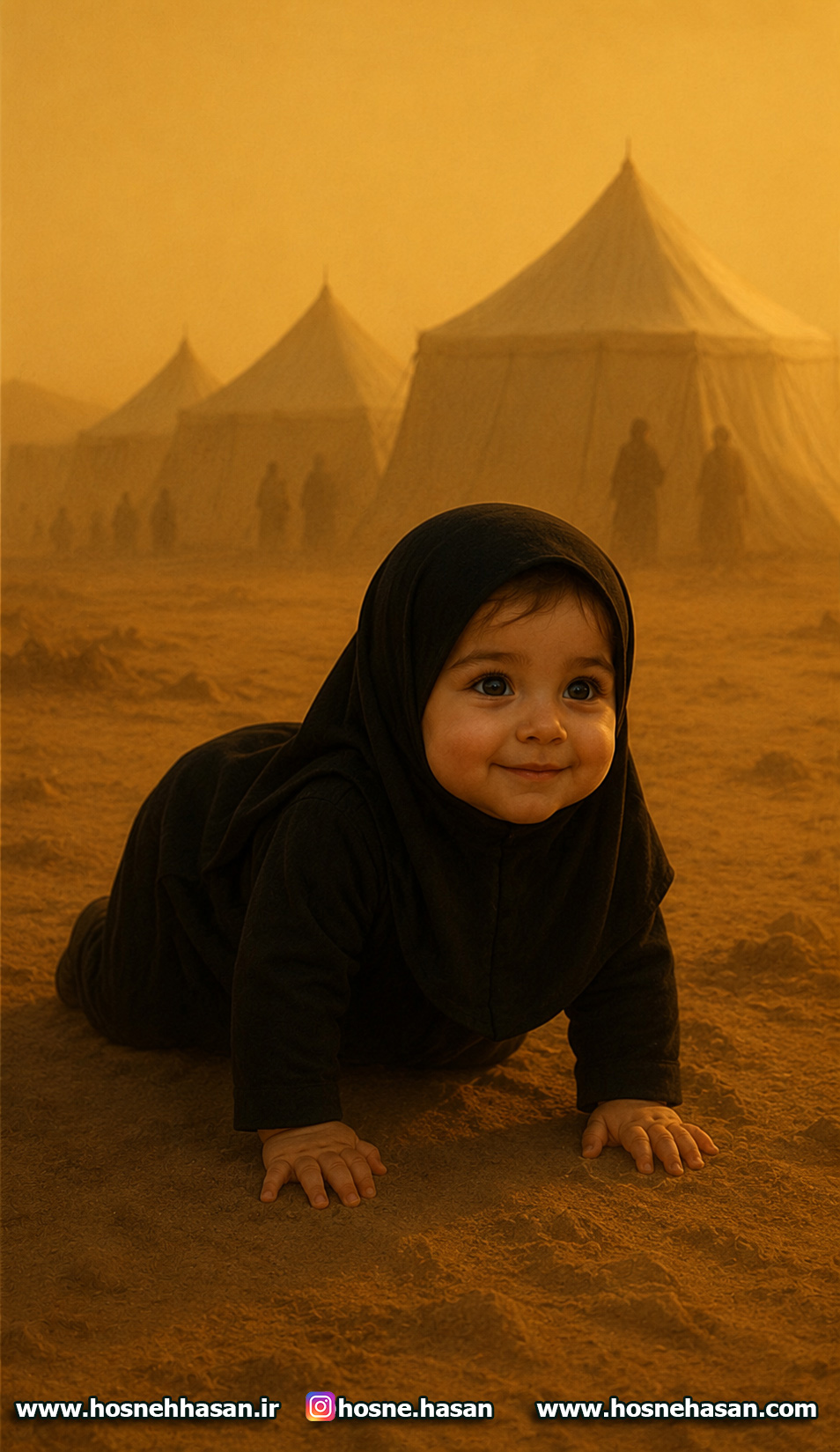
After the martyrdom of Imam Hussain (a.s.) on the afternoon of Ashura in the year 61 AH, the cavalry of Umar ibn Sa'd's army charged towards the tents; their aim was to plunder and burn the tents together with the women and children inside them. As the enemy horsemen drove into the tents of Aba Abdillah, Lady Saboora (a.s.) — who was barely one year old and still crawling on all fours — fell beneath the hooves of the attackers' horses and was martyred.
Seeing the enemy's assault on the tents, Lady Zaynab (a.s.) hurried to the tent of Imam Sajjad (a.s.). Imam Sajjad (a.s.) was gravely ill and in pain. Lady Zaynab told the Imam that the enemy was attacking the tents and asked what he commanded. The Imam said: tell all the children and women to flee quickly into the desert so that they may live; for the enemy's aim, besides plundering the women and children, was to burn the tents with everyone inside them.
Lady Tahoora (a.s.) and Lady Saboora (a.s.) fled swiftly towards the desert and got away from that place of destruction. On the eleventh night of Muharram more than half the moon was bright. At sunset, Zaynab al-Kubra (a.s.), the noble lady of the Banu Hashim, turned to Umar ibn Sa'd and said: return one of our tents to us so that we may set it up and gather the children. Umar ordered that they be given one tent — one corner of which had caught fire — and they raised it; and Lady Zaynab, together with Lady Umm Kulthum, began gathering the children and brought them all together into that half-burnt tent.
Then they realised that two little ones were missing. Lady Zaynab (a.s.) said to her sister Umm Kulthum (a.s.): there is no choice but that you place your hand in mine, that we take to the desert and find the children. For a moment a dark shape in the distance caught their attention; they went forward and Umm Kulthum called out: my sister Zaynab, there is something dark here! They went and saw two children lying there asleep, as though they had grown tired and sleep had overcome them. They decided to lift the children gently so that they would not wake. When they quietly took them into their arms, they realised that their heads had fallen back. Looking closely, they saw that both girls had died — they had been martyred.
Lady Tahoora (a.s.) and Lady Saboora (a.s.) had been martyred beneath a bush in the desert, from severe thirst and exhaustion, in each other's arms.
What you have read is the account of the martyrdom of three oppressed and unnamed children of
Imam Hussain (a.s.): Safoora (a.s.), Tahoora (a.s.) and Saboora (a.s.) — children whose names,
by God's grace and favour, Allamah Hasanzadeh Amoli was granted the honour of making known after
more than 1300 years.
It now falls to us, the followers of the Commander of the Faithful (a.s.) and of Imam Hussain
(a.s.), to draw these dear ones out of anonymity with all our strength and effort, and to make
them known to the Shia and the lovers of the Ahl al-Bayt (a.s.) throughout the world. May
everyone who takes a step along this path receive the favour of Sayyid al-Shuhada (a.s.), of
Zaynab al-Kubra (a.s.), and of these three pure pearls of Imam Hussain (a.s.).
From virtue to narration: Safoora, Tahoora and Saboora (a.s.)
How Safoora (a.s.), Tahoora (a.s.) and Saboora (a.s.) were martyred
The narration in this video is in Persian.
Allamah Hasanzadeh Amoli's rawdah on the night of Sham-e Ghariban of Imam Hussain (a.s.)
From tomorrow night the moon becomes full. Tonight, the eleventh night of Muharram, more than half the moon is bright; a person can walk through the desert by its light. This afternoon, at sunset, Zaynab al-Kubra (a.s.), the noble lady of the Banu Hashim — while Imam Zayn al-Abidin (a.s.) was gravely ill — turned to Umar ibn Sa'd and said to him: return one of our tents to us so that we may set it up and gather the children. Umar ordered that they be given one tent, one corner of which had caught fire, and they raised it. Here and there, on this side and that, they gathered their little ones and their children.
They realised that two little ones were missing. Lady Zaynab (a.s.) said: my sister Umm Kulthum (a.s.), there is no choice but that you place your hand in mine, that we take to the desert and find the children. It is night and the moon is shining; from one side the cameleer has come to Imam Hussain (a.s.), from the other the women go to their little chicks — what passed over them!
They went this way and that; one sister said to the other: my dear sister, I have found them! I have found our lost ones. The two children had grown tired on the edge of the desert, had fallen to the ground, lain down and been overcome by sleep. I will lift one and you lift the other. Tonight is Sham-e Ghariban; what do they want of this Sham-e Ghariban? Their words are: O Aba Abdillah, we are going in search of those two lost children.
Well, they found the children. My dear sister, you take one in your arms and I the other. They are taking the children into their arms — alas! alas! They are not asleep; our children are dead!
The two little children
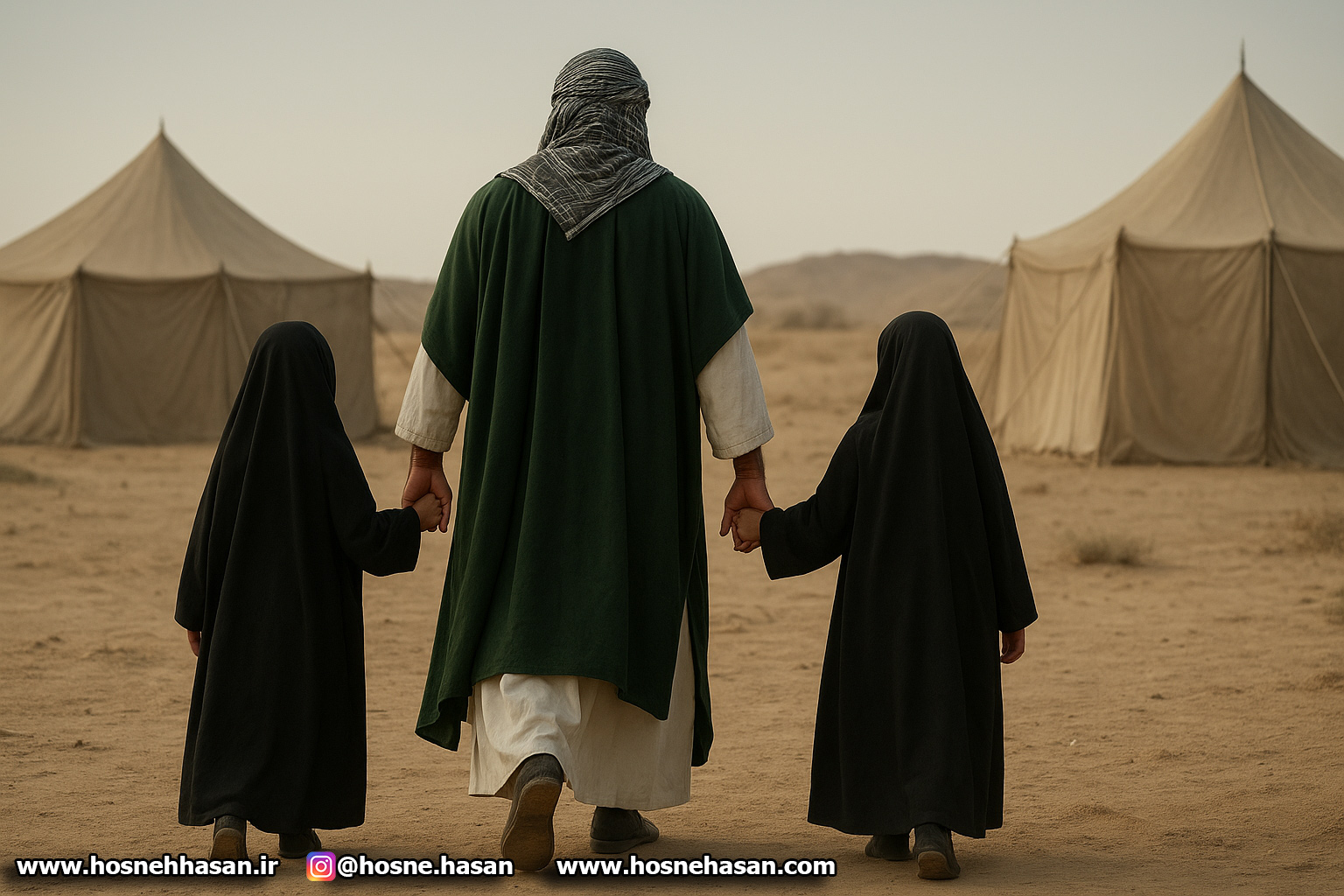
Ustad Samadi Amoli on Lady Safoora (a.s.) and Lady Tahoora (a.s.)
Lady Zaynab (a.s.) said: Umm Kulthum, let us call the children to see whether we have them all; perhaps some have been lost. They called the children one by one, and saw that two of the beloved daughters of their master Hussain (a.s.) were missing. Zaynab's weeping rose: ah, my dear ones, where are you lost? Where have you gone? Come now, all of you, let us go; this is Zaynab's Sham-e Ghariban — let us go after the children and see where they are. Umm Kulthum, come, let us go together and search this desert for the children. As they were searching and looking beneath the bushes and the mughaylan thorn, all at once Umm Kulthum (a.s.) saw a particular dark shape in the distance. She said: my dear sister Zaynab, there is something dark here, perhaps it is them. She said: yes; they went forward, they went a little further, and saw: yes, two little girls are lying here asleep. May I be sacrificed for my master; two years ago, in the days of Ashura, we were honoured to be in his presence and he said: those two children who were lost that night were two daughters of Hussain (a.s.). He said: what I am saying now you will not find or read in any book; this is written in the book of the world's creation, and we have read it; there it is written that the names of these two daughters of Sayyid al-Shuhada are Safoora and Tahoora.
My dear ones, keep these two names alive. Ah, Zaynab, the children have been found, praise be to God. My dear sister Umm Kulthum, it is dark now, it is night, and they are asleep; from morning until noon they saw all those scenes, and the afternoon passed in such days of martyrdom, and now they have seen the burnt tents, and they have come all this way in these deserts, grown tired, and sleep has overcome them. So let us lift these two dear ones gently so that they do not wake, and carry them to the tent. They lifted them with great care; and when they raised these two dear ones from the ground, all at once they realised that their heads had fallen back. They looked closely — ah, they saw that both girls had died! O Hussain!
Ustad Samadi Amoli on Lady Safoora (a.s.) and Lady Tahoora (a.s.)
O beloved Safoora, O beloved Tahoora, our hands are upon your hems! May I be sacrificed for you, my master {Allamah Hasanzadeh}; you said that in the book of creation it is written that the names of those two dear ones, tonight, are Safoora and Tahoora. O two beloved of Hussain, our hands are upon your hems tonight; take our hands and lift us up, for we are weary. Ah, we have become the staff-bearers dwelling in Hussain's ruin, we have become the owls of Zaynab's ruin. My dear one, the two children were brought — what shall we do? Zaynab has sorrows to pour out.
She has left two of Aba Abdillah's children in Karbala, left Muslim's two children in Kufa, and left beloved Ruqayyah behind in Damascus. O aunt, may I be sacrificed for you; for Zaynab says: with what face shall I now return to Medina? Ah, what shall I say to the mothers, what answer shall I give the people of Medina?
There is no god but God. Near the sunset of Ashura, Zaynab (a.s.) went and said: Umar ibn Sa'd, we are the household of the Messenger of God; your soldiers have plundered our mantles and head-coverings and burnt our tents. Umar ibn Sa'd, do you claim to be a Muslim? Is this the way of Islam? Umar ibn Sa'd ordered that their belongings be returned; no one brought anything, and only one half-burnt tent remained. Lady Zaynab (a.s.) gathered the children under that tent. Perhaps each of the children was saying: aunt Zaynab, a mughaylan thorn has gone into my foot. Ah, and the women who had lost their children — like Rubab (a.s.), who had lost Ali al-Asghar (a.s.). Suddenly Zaynab (a.s.) heard the sound of weeping in a corner of the tent. She kept soothing the children, then went towards that weeping and saw that it was Rubab (a.s.), the mother of Ali al-Asghar (a.s.). Rubab, why are you weeping? Dear Zaynab, now that they have given us a little water, now that I have drunk, my breast has milk; and grief for Ali al-Asghar is burning me. Today he kept fretting; I would put my breast to his mouth, he would suckle a little, find there was no milk, let go, cry and thrash about. Now that my breast has milk, I do not have Ali al-Asghar — to take him in my arms and say: my son, you were so thirsty, you were so hungry.
Imam Zayn al-Abidin's fever had risen and his illness had grown severe. For some part of the night, Zaynab (a.s.) was occupied with tending the women and children. At last Zaynab (a.s.) settled them all to sleep. My dear one, last night master Aba Abdillah said: my dear sister Zaynab, do not forget me in your night prayer. Imam Zayn al-Abidin says: at dawn I saw that my aunt Zaynab (a.s.) had gone out of the tent; when I listened carefully, I heard the sound of her prayer. I put my head out of the tent and saw my aunt sitting and praying. Dear Hussain, grief for you has taken the strength from my knees; I no longer have the endurance to stand.
Ustad Samadi Amoli on Lady Safoora (a.s.) and Lady Tahoora (a.s.)
Lady Zaynab (a.s.) said: Umm Kulthum, let us call the children to see whether we have them all; perhaps some have been lost. They called the children one by one. According to one historical account, Hazrat Muslim's two children had fled that afternoon, lost their way and gone towards Kufa. When they called out, they saw that two children of master Aba Abdillah (a.s.) were missing; beloved Safoora and Tahoora were missing. Ah, under the moonlight they go out into the desert, searching beneath the bushes with Umm Kulthum. All at once a dark shape in the distance caught their attention; they went forward and Umm Kulthum called out: my sister Zaynab, there is something dark here. They went and saw two children lying asleep here, as though they had grown tired and sleep had overcome them. Ah, dear sister, let us lift the children gently into our arms so that they do not wake. When they took them into their arms, they realised that both had died.
Ustad Samadi Amoli on how the names of Safoora (a.s.), Tahoora (a.s.) and Saboora (a.s.) came to light
The master's three beloved daughters — Safoora, Tahoora and Saboora: all three of these names were drawn from the unseen by your renowned scholar, his eminence {Allamah Hasanzadeh}, may my spirit be his ransom. In those same years when there was a class in Qur'anic exegesis in his presence, in the master's mosque, the discussion was on the Qur'anic sciences; one of the dear ones said, either that same day or the next: when the exegesis session began, at the very start of the gathering, I was sitting in the Sabzeh-Meydan mosque of Amol, which has come to be named the mosque of Allamah Hasanzadeh Amoli. He said: all at once I saw the scene of Karbala take shape before me — the scene of the horses entering the encampment of Aba Abdillah. Suddenly, for an instant, without intention and without any precedent, I was no longer in that space; all at once I saw the horses charge towards the master's tents, and a little girl fall beneath the horses' hooves and be killed; and after a moment that scene ended. Two years later, in the month of Ramadan when we had the honour of being in Karbala, the account of Lady Saboora (a.s.) reached us in the shrine of Hazrat Abul-Fadl (a.s.), from our dear master.
The account of Lady Saboora (a.s.), this beloved daughter of Imam Hussain (a.s.): when the enemy's cavalry charged into the tents of Aba Abdillah — entering through one particular opening — this beloved daughter named Saboora (a.s.) fell beneath the hooves of the attackers' horses and was killed.
How harmonious and measured these names are! Well — if there was this Safoora, this Tahoora, this Saboora, how many descendants through the daughters of Imam Hussain (a.s.) ought we to have today? Is not the whole of the Prophet's progeny through his one daughter, Lady Fatimah al-Zahra (a.s.)? Inna a'taynaka al-kawthar.
The miraculous healing of an incurably ill man through Lady Safoora (a.s.) and Lady Tahoora (a.s.)
A dear man was ill for several years, until at last they took him to Tehran. I will tell you very briefly; God willing, we mean to go to Safoora and Tahoora. May I be sacrificed for our master {Allamah Hasanzadeh}; ten years ago he said: two of the daughters of Aba Abdillah (a.s.) are Safoora and Tahoora.
They took him to Tehran for treatment; he had a brain tumour. When they operated on him, the doctors said he would be paralysed; his whole head and face would be paralysed, his whole body would be paralysed. They telephoned his mother and family and asked after him; they said: nothing can be done, consider him dead. His mother would go from the house to the neighbouring Abul-Fadl husayniyyah on all fours; she would go into the husayniyyah, take hold of a cradle bearing the name of Ali al-Asghar (a.s.), and say: Ali al-Asghar, you must save my son… And while the mother was there lamenting and pleading — I do not know what the mother did — he was in Tehran, on his sickbed, unconscious and in a coma. He says: I went to a land, a desert; and I see Karbala standing there. He has memories of this kind. Suddenly I saw two little girls beneath a bush calling me: come, come, come! I went; they took me under the arms, one on this side and one on that; they lifted me and walked me along. I say: who are you? They say: never mind that, we will make you well. I said: no, I must know who you are. They said: we are Safoora and Tahoora, we are the daughters of Hussain. By God, he was not much of a mosque-goer, nor one for the husayniyyah and the gatherings of mourning; nor had he ever heard the names Tahoora and Safoora until then — not even in these few years in which we have been relating them had it reached his ears. He said: these two girls, about three or four years old, lifted me up; where we were walking was sand and gravel, and I would sink into that sand, but they would not sink. All the doctors realised that his condition was normal, that he was coming out of the coma. May I be sacrificed for Safoora and Tahoora! They said to him: you must certainly go and tell the people; for we have been lost for a whole age! You weep for your missing ones — why do you not weep for us? We have neither name nor remembrance…
This dear man said: I saw those two as well, beneath that same bush, upon the soil of Karbala, laying down their heads and giving up their souls in utter thirst. However much I said to them: lay your heads in my lap, they said: no! Because our father was martyred upon the soil, we too wish to be martyred upon the soil…
O Safoora, O Tahoora…
I do not know — no one has related it — but perhaps Lady Ruqayyah (a.s.) kept saying along the road of captivity: dear aunt! What became of my sister Safoora? What became of my sister Tahoora?…
یا صفورا یا طهورا یا صبورا
یا طهورا یا صفورا یا صبورا